Friday, 3 June 2011

Nelliyampathy

         Nelliyampathy is the place that is famous for oranges. It is also known as Ooty of the poor. It is located about 9 km southeast of Nenmara. From the village Nenmara, in Palakkad district caressed the tops of clouds of the majestic hill range Nelliyampathy a sight to behold. The height ranges of hills from 467 m to 1572 m. To achieve Nelliyampathy, take the road of the product Nenmara Pothundy Dam. There are about 10 turns to negotiate on the way Nelliyampathy.
  Pothundy Dam is a picturesque village, with facilities for boating, and is an attractive option as a place for picnics. As the Ghat road winds its way up Nelliyampathy, some places have views of the largest sections of Palakkad district are displayed in large rice fields, which are lush carpet. It also offers a spectacular view of Palakkad Gap, which is a geographical phenomenon in the Western Ghats region, leading to the formation of visible parts of neighboring Tamil Nadu state.
Tea Garden
On the way, estates that are interested in organic farming may look more closely in the management of private farms and vast expanses of tea estates managed by different companies. Nelliyampathy Hills is also known for its orange cultivation.
Private hotels and resorts are located in different places as you go up the hills Nelliyampathy. Bio-farms located here are an important step in the return before it reaches the highest point Palagapandi true heritage. The state is a charming villa, built during the British rule in India, and has now been changed to a privately owned resort. This Kaikatty, community room is available, which is usually used as a base, who are interested in hiking.
   Nearby Palagapandy Seetharkundu is where you can get a spectacular view over the valley, and a cascade of 100 m height provides an added attraction. Palagapandy of you can go trekking or jeep to reach Mampara, another point of view breathtaking Nelliyampathy. The area in and around the property has Palagapandy tea, cardamom and coffee plantations with adjoining hills allowing one to catch a glimpse of wildlife in the form of Indian gaur, elephants, leopards, giant squirrel etc. and is also a paradise for birdwatchers.
Location: About 55 km from Coimbatore. Only 52 km from Palakkad Railway Station.

Parambikulam Wildlife Sanctuary

                                                                           Nestled in the valley between the rows Anamalai of Tamil Nadu and Kerala Nelliampathy ranges of the majestic Western Ghats is Parambikulam Wildlife Sanctuary.This pristine valley that is proud of Palakkad district is a glorious tribute to untouched container ports nature.The several variants the aquatic fauna, including crocodiles assailant, who are often seen sunbathing along its banks.
Deer
         Parambikulam Wildlife Sanctuary is the most protected environment for Anamalai subunit of the Western Ghats, surrounded on all sides by protected areas and sanctuaries of Kerala and Tamil Nadu, the sanctuary has a flora and fauna that are peninsula well preserved due to the full protection of minimum human intervention. The sanctuary is a major ecological continuum Peechhi through substantial aid Eravikulam Anamalai viable populations of wildlife. It houses various breeds of indigenous peoples who are equally good part of the existing harmonious ecosystem. The thick, rich habitat sanctuary supplys abundant water make it a habitat for wildlife and therefore for the tourist who may have fond memories of watching animals and being in the bosom of nature.
Wild Cat
Western Ghats is one of 34 global biodiversity hotspots. Considering the abundance of wildlife and natural beauty adorable Parambikulam Wildlife Sanctuary is perhaps the most interesting part of the wildlife in the entire stretch of Western Ghats. Therefore, it is popularly venerated as a "house of Nature." Has a total area of ​​285 sq.km
Buffalo

Location: About 40 km from Mannarkkad in the district Palakkad. From Palakkad - 100 km, From Coimbatore (Tamil Nadu) - 84 km, From Pollachi (Tamil Nadu) - 38 km.

Thursday, 2 June 2011

Silent Valley

Silent Valley
Silent Valley National Park is located in the Nilgiri Hills, Palakkad District in Kerala, South India. The area in this national park was historically explored in 1847 by the botanist Robert Wight, and is associated with Hindu legend. The park is one of the last undisturbed tracts of South Western Ghats montane rain forests and tropical moist evergreen forest in India. Contiguous with the proposed Karimpuzha National Park (225 km²) to the north and Mukurthi National Park (78.46 km²) to the north-east, it is the core of the Nilgiri International Biosphere Reserve (1,455.4 km²), and is part of The Western Ghats World Heritage Site, Nilgiri Sub-Cluster (6,000+ km²) under consideration by UNESCO. Plans for a hydroelectric project that threatened the parks high diversity of wildlife stimulated an environmentalist Social Movement in the 1970s called Save Silent Valley which resulted in cancellation of the project and creation of the park in 1980. The visitors' centre for the park is at Sairandhri.
Lion-tailed macaque
Silent Valley gets copious amounts of rainfall during the monsoons, but the actual amount varies within the region due the varied topography. In general the rainfall is higher at higher altitude and decreases from the west to east due to the rain shadow effect. Eighty per cent of the rainfall occurs during the south-west monsoon between June and September. It also receives significant amount of rainfall during the north-east monsoon between October and November.
Bridge across the river Kunthi
The park consists of several species of birds, animals and other living organisms. Birdlife International 16 bird species in Silent Valley as threatened or restricted: Nilgiri Wood-pigeon, Malabar Parakeet, Grey-headed Bulbul, Broad-tailed Grassbird, Rufous Babbler, Wynaad Laughing Thrush, Nilgiri Laughing Thrush, White-bellied Shortwing. Rare bird species found here include Ceylon Frogmouth and Great Indian Hornbill.
There are at least 34 species of mammals at Silent Valley including the threatened Lion-tailed Macaque, Niligiri Langur, Malabar Giant Squirrel, Nilgiri Tahr, Peshwa’s Bat (Myotis peshwa) and Hairy-winged Bat. There are nine species of bats, rats and mice.

Location: Silent Valley National Park located 40 km from Mannarkkad in the Palakkad district.

Malampuzha Dam

Malampuzha Dam
      Malampuzha Dam is the largest reservoir in Kerala, which is located near Palakkad in southern India is on the scenic hills of Western Ghats in the background. The dam project was initiated in 1949 and graduated in 1955. The entire catchment area of ​​145 square kilometers, where the tank has a capacity of 8000 square meters of water. duct systems serving the irrigated agricultural land when the reservoir provides drinking water Palakkad and surrounding villages.

Malampuzha, a small town in the foothills of Western Ghats takes its name from the river Malampuzha. Nurtured by this tributary of Kerala's longest river, Bharathappuzha, Malampuzha is a green city is a major tourist attraction for its hiking trails and irrigation dam large.
Around the reservoir are beautiful gardens and amusement parks. services can be found in the lake by boat. Other attractions in the Malampuzha garden a beautiful rock garden, fish-shaped aquarium, snake park, cableway, which takes aerial tour of the park and the gigantic Yakshi (enchantress) sculptured by Kanai Kunhiraman, a renowned sculptor of Kerala.
Entrance to the garden
The most interesting feature of the rock is the whole place is made of pieces of unwanted and broken bangles, tiles, used plastic cans, boxes and other debris. The garden is a masterpiece of sculptor Padmasree Neck Chand Saini. His rock garden in Chandigarh is world famous and attracts thousands of tourists every year. Nearest station and the airport is in Palakkad and Coimbatore, respectively.

Location: Only 10 km from Palakkad town, North Kerala.

Cheraman Juma Masjid

Cheraman Juma Masjid
Interior
                  Cheraman Juma Masjid is a mosque in Kodungallur in the Indian state of Kerala. Probably constructed during the lifetime of Prophet Muhammad, the bodies of some of his original followers are said to be buried here. Unlike other mosques in Kerala that face westwards this mosque faces eastwards.The mosque is built in the traditional Hindu architectural style using brass oil lamps. The rosewood pulpit, from where the imam recites the Friday Jumu'ah, is covered with carvings. A block of white marble in the mosque is believed to have been brought from Makkah.
It is believed to be built in 629 AD by Malik Bin Deenar, Cheraman Juma Masjid is considered as the oldest mosque in India and the second oldest mosque in the world to offer Jumu'ah prayers. Constructed during the lifetime of Muhammad, the bodies of some of his original followers are said to be buried here. Unlike other mosques in Kerala that face westwards this mosque faces eastwards. Though, generally it is considered to be the second mosque of the world after the mosque in Medina, Saudi Arabia.
The legend has it that a group of Muhammad's Sahaba (companions) visited Kodungallur. An unknown Chera dynasty ruler had witnessed a miraculous happening — the sudden splitting of the moon, the celebrated miracle of Muhammad — and learned on inquiry that this was a symbol of the coming of a Messenger of God from Arabia. 
An Old Photo
Soon after, Perumal travelled to Makkah, where he embraced Islam, and accepted the name Thajudeen. On his way back to India he died at Salalah in the Sultanate of Oman. On his deathbed he is said to have authorised some of his Arab companions to go back to his kingdom to spread Islam. Accordingly, a group of Arabs led by Malik Bin Deenar and Malik bin Habib arrived in north Kerala, and constructed the Cheraman Juma Masjid at Kodungalloor.

Location: Cheraman Juma Masjid is Located 2 km from Kodungalloor town and 20 km from the Irinjalakuda Railway station.

Athirappally Waterfalls

Athirappally Waterfalls
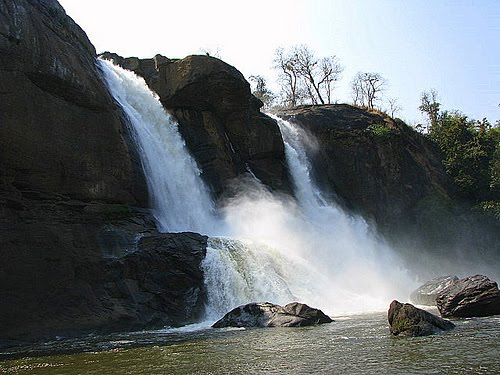
            Athirappally Waterfalls is located at the entrance to Sholayar ranges, this waterfall is a popular picnic spot. The charm of the Athirampally and Vazhachal nature cannot be described by words, Starting calmly from the high ranges, and crashing through gorges overhung with trees, these waterfall is one of the best places in India to re-capture a real sense of the classical idea of the 'Picturesque' - not just calm and sweet, but something wild and natural.
 Affording to the onlookers, one of the most bewitching sights, Athirappally Falls is about 80 feet high and located in the forest area.   Combined with the greenery, it infuses freshness into any tired soul.  The Athirapally Falls join the Chalakkudy River after plummeting a drop of 80 feet.
Athirappally Waterfalls
While the waterfalls are the highlight of this region, there are quite a few places to see in and around Athirapally. The Vazhachal waterfalls are located very close to the Athirapally falls and are a part of the Chalakudy river stream. Vazhachal is popular for its flora and herbal plantations (maintained by the forest department) apart from the scintillating waterfalls set in the backdrop of a lush green forest. This is an ideal picnic spot too.
Two water-theme parks - the Dream World and Silver Storm are located to the west of Athirapally. The Thumpurmuzhi gardens are located amidst the two water theme parks. The water from the river is redirected to deep tanks at Thumpurmuzhi, creating a waterfall like impact. The gardens are well maintained and have scenic surroundings. The lesser-known Charpa falls are situated to the east of Athirapally. The water plunges on to the road in the monsoon, so get ready to get drenched if you are visiting it in the rainy season.
If you take a ride through the deep forest and high ranges you will come across the Malakapara tea gardens. Around 50 kilometers from Athirapally, this tea garden has picturesque surroundings and sometimes one can spot wildlife here.
Athirappally Waterfalls
Vachumaram is a calm and beautiful lake surrounded by hills. If you are lucky, you can spot deer and wild elephants here. A few kilometers from Vachumaram (about 20 kilometers from Chalakudy) is Anakkayam (which means elephant pit). Tourists will find a serene lake, bubbling streams, natural rock formations and flora here.
A tranquil and much needed escape from the troubles and stress of life. Let the soothing sounds take you to some of nature’s most relaxing places - the beautiful waterfalls of Athirampally and Vazhachal (Prounced as vaazhachaal).

Location: Located at a distance of 78 km from Kochi.

Guruvayur Temple

East gate/Kizhakke nada
                             Guruvayur is a well known krishna temple in India.It is one of the five famous Krishna\Vishnu temples in India. The others are Jagannath Puri in Orissa, Venkatachalapati in Andhra Pradesh, Nathdwara in Rajasthan and Dwaraka in Gujarat. Of course there are many other famous ones of Vishnu as well as of Krishna but these are considered to be the most popular. Even though the idol in Guruvayoor is that of Vishnu it is still known as a Krishna temple since the boy Krishna is always said to be running around incognito in the temple precincts. Guruvayoor is known as “Bhuloka Vaikunta” or the abode of Vishnu on earth.

           Lord Krishna in Guruvayoor is popularly called Sri Guruvayoorappan. Appan means lord or father so the title means the Lord of Guruvayoor. 
The small idol is made of the stone known as black antimony and is a magnetic stone said to have special medicinal properties. Every morning the Lord is anointed in oil. He is then sprinkled with a special cleansing powder made of herbs known as “vaka”. This powder is light brown in colour and gives an added hue to the idol.  Crowds go to the temple at 3 A.M in order to see this charming sight. Then water from the temple, consecrated with mantras is poured over the idol for his ritual bath. This holy water is then eagerly drunk by the devotees since it is said to contain a little of the miraculous properties of the stone of which the idol is made.
Devotees at West Gate
Location: The National highway is passing through Kunnamkulam which is just 8 kms away from Guruvayur. Around 80 km from Kochi.
Related Posts Plugin for WordPress, Blogger...